A free guide from Quick VOB
Behavioral health carve-outs: spot them before you admit
The card says Blue Cross. The benefits check says active. Three weeks later the claim comes back, because a different company holds the substance use benefits and the authorization. Here's how to spot a carve-out on the card and in the eligibility response, and what to do when you find one.
Updated October 24, 2026. Written by an IOP/PHP program's admissions and billing team.
1. What a carve-out is
In a behavioral health carve-out, the medical plan hands its mental health and substance use benefits to a separate company, often called a managed behavioral health organization. That company usually runs the behavioral health network, prior authorization and utilization review, and often the claims too. The medical plan keeps everything else [1].
You may hear two names for it:
Carve-out
The employer contracts directly with a behavioral health company, and the medical plan leaves mental health and substance use care out.
Carve-in
The health plan itself subcontracts its behavioral health benefits to a behavioral health company, or owns one.
For admissions, the difference rarely matters. Either way, someone other than the company on the front of the card may decide your authorization and pay your claim. The rest of this guide calls both a carve-out.
2. The companies you'll see
| Company | What to know |
|---|---|
| Optum Behavioral Health (United Behavioral Health) | A UnitedHealth Group company [2]. Manages behavioral health for UnitedHealthcare and for some other plans: Point32Health, for example, says UBH handles behavioral health authorizations for certain of its Medicare Advantage members [3]. |
| Carelon Behavioral Health | Elevance Health's behavioral health company. Known as Beacon Health Options until it took the Carelon name in 2023 [4], so older cards and letters may still say Beacon or ValueOptions. |
| Magellan Health | Owned by Centene since January 2022, and run as its own company [5]. Manages behavioral health benefits for health plans and employers. |
There are others, and the arrangement can differ between two members of the same insurer, because it follows the employer group or the product, not the brand on the card.
3. Why carve-outs cause denials
- The authorization came from the wrong company. The medical plan's precert line may tell you nothing is needed, while the carve-out requires an authorization for PHP or IOP.
- The claim went to the wrong payer ID. The medical plan denies or forwards it, and the timely-filing clock keeps running.
- Network is decided separately. Being in network with the medical plan doesn't mean you're in network with its behavioral health company, which credentials and contracts on its own.
- The benefits check looked fine. The medical plan's eligibility response can show active coverage and general benefits while the details that matter to you live with the carve-out.
- A different member ID. The carve-out may know the member by another number.
4. How to spot one on the card
Get a photo of the front and the back. Look for:
- A second company's name or logo, often on the back: "Behavioral health services provided by…"
- A separate phone number labeled behavioral health, mental health and substance use, or MH/SA.
- A separate claims address or payer ID for behavioral health claims.
- A separate precertification line for behavioral health or for "MH/SUD."
The card is a clue, not the answer. Cards are printed once and arrangements change, so confirm with the eligibility response and the call.
5. How to spot one in the 271
The eligibility response your clearinghouse returns (the X12 271) has a few ways of pointing to another company:
| In the 271 | What it means |
|---|---|
| Benefit code U, with a company named | "Contact following entity for eligibility or benefit information." X12 describes it as pointing to the true source of the member's eligibility or benefits [6]. On a mental health or substance use service type, that's usually the carve-out, sometimes with its phone number and the member's ID there. |
| Benefit code R | "Other or additional payer": another insurer is on file. Sort out which one is primary before you bill. |
| A free-text message | Lines like "behavioral health benefits managed separately" or "carved out to…" in the payer's notes. |
| Silence on behavioral health | Active coverage and general benefits, but nothing back for the mental health or substance use service types you asked about. Not proof of a carve-out, but a reason to call. |
6. What to do when you find one
- Run a second benefits check with the carve-out, using its own payer ID and the member ID it gave, if it gave one.
- Call the carve-out's behavioral health line, not the medical plan's member services, and ask the level-of-care questions from our VOB checklist.
- Confirm your network status with the carve-out.
- Get the authorization from whoever the carve-out says decides it, and record which company gave it. Our prior authorization guide covers what reviewers ask.
- Put both companies on the VOB: the medical plan, the carve-out, the payer ID and claims address for behavioral health claims, and the rep and reference number from each call.
7. How Quick VOB flags carve-outs
When the payer's answer names another company for some benefits, Quick VOB says so at the top of the check, in plain words: which benefits, which company, the member's ID there and their phone number when the payer sends them.
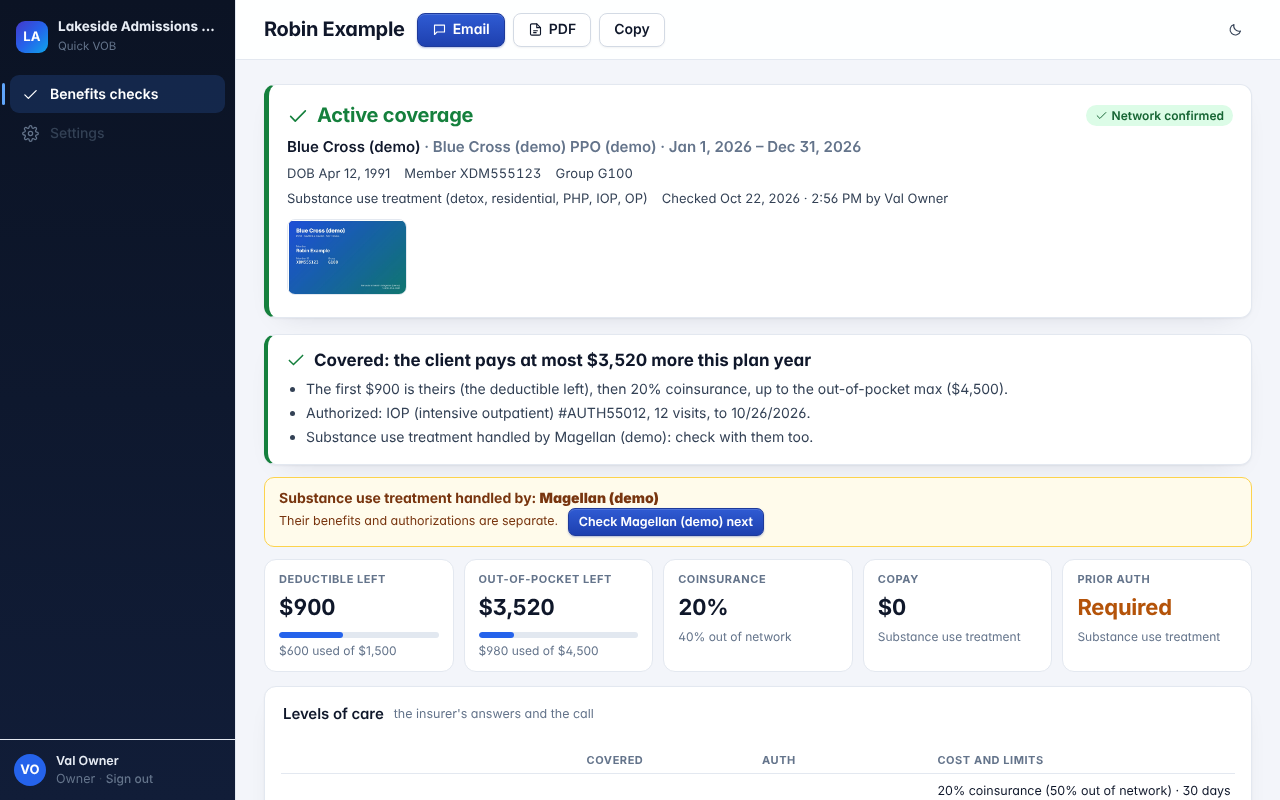
A demo check with a made-up member and demo insurance: the carve-out is in the summary and in its own alert.
- Check them next. One tap starts a new check with the person, the carve-out's name and the member ID it gave already filled in. You pick the carve-out's payer from the list and run it.
- Call the right number. Quick VOB reads the behavioral health line from the card photo, and in "Log the call" that number is one tap away on a phone.
- Keep both answers. Each check is saved, and the carve-out is on the VOB PDF under "what to watch," so billing sees it too.
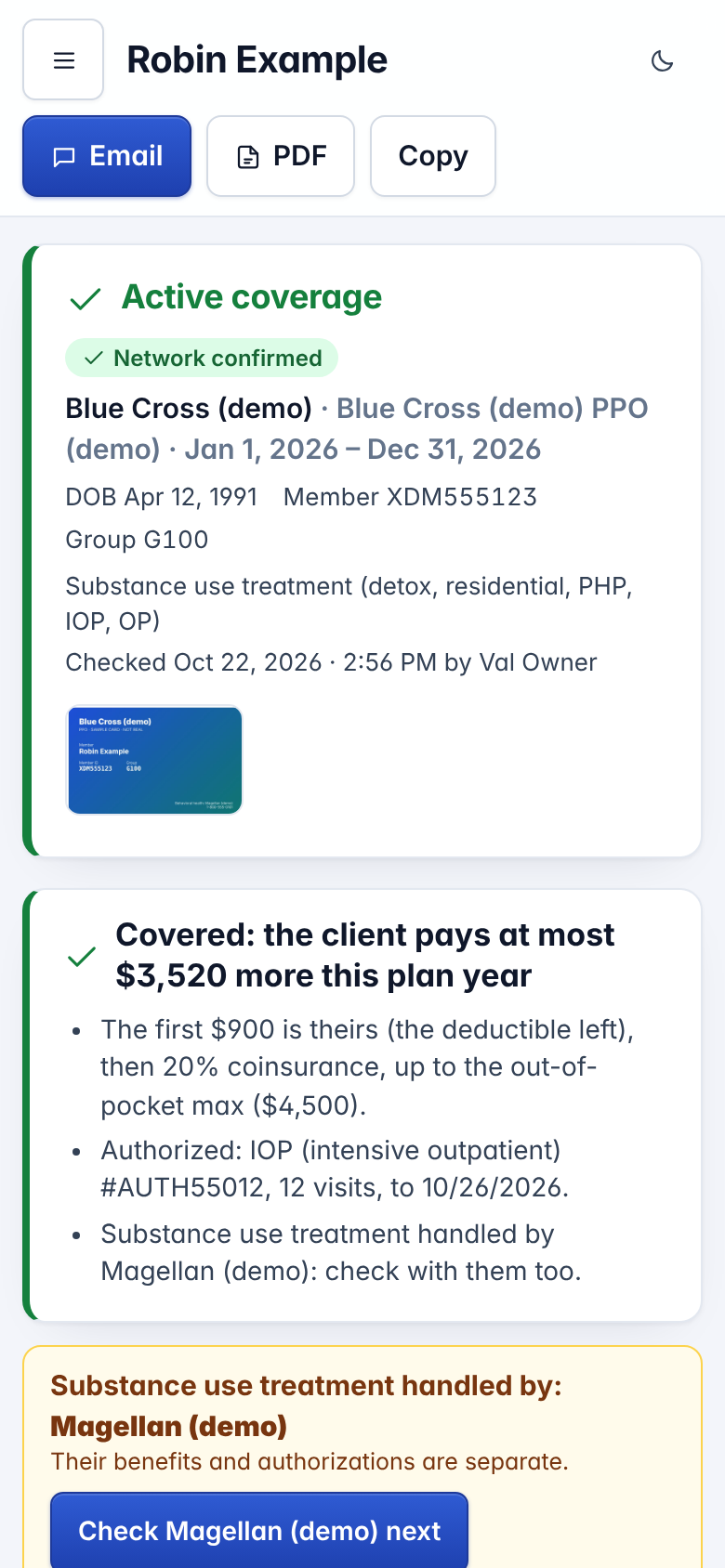
The same check on a phone.
Quick VOB can only flag what the payer sends or the card shows. When neither names a carve-out, the call to the behavioral health line is still the way to be sure.
Catch the carve-out before the denial
Snap the card, see the benefits in about a minute, and check the carve-out in one more tap. $99 a month for the whole team.
More from Quick VOB: the VOB checklist · prior authorization guide · VOB software vs outsourcing · Quick VOB questions · Quick VOB home
Sources
- "Carve-outs," in the Encyclopedia of Health Care Management (SAGE). sagepub.com
- Optum, National Network Manual (United Behavioral Health, operating under the brand Optum), as posted by the Maryland Department of Health. health.maryland.gov
- Point32Health, "Optum/United Behavioral Health" (provider page). point32health.org
- Behavioral Health Business, "Elevance's Beacon Health Options rebrands to Carelon Behavioral Health," March 2, 2023. bhbusiness.com
- Centene, "Centene Completes Acquisition of Magellan Health," January 4, 2022. centene.com
- X12, Request for Interpretation 1821: EB*R vs EB*U vs EB*W (270/271). x12.org
This guide is general information, not legal or billing advice. Company names are used only to describe who manages benefits; arrangements differ by plan and change. Confirm with each plan.