A free guide from Quick VOB
How to read an eligibility response (X12 271) for mental health and substance use care
The service type codes that matter for behavioral health, what each EB code means, how to tell a total from an amount left, and a worked example decoded line by line. For admissions and billing staff who look at raw 271s, clearinghouse screens or payer portals.
Updated October 24, 2026. Written by the team that runs a licensed Texas IOP/PHP program and built the benefits reader in Quick VOB.
The short answer: a 271 is a list of benefit lines (EB segments). For each line, read five things: EB01 says what kind of fact it is (C deductible, G out-of-pocket, A coinsurance, B copay, 1 active, U "call this other company"); EB03 says which service it's for (MH mental health, AI substance use, CI and CJ substance use facility inpatient and outpatient, BB partial hospitalization, 30 the plan in general); EB06 says the period (23 calendar year = a total, 29 = what's left); EB07 or EB08 is the dollar amount or the percent; and EB12 says in network (Y) or out of network (N). Met = total minus left.
1. What a 271 is
The 270 is the eligibility question your clearinghouse sends to a payer; the 271 is the payer's answer. HIPAA names the ASC X12 270/271 as the standard for eligibility inquiries between providers and health plans (45 CFR §162.1202), which is why nearly every commercial plan, Medicaid managed care plan and Medicare Advantage plan answers one. A payer portal's "eligibility and benefits" screen, and most VOB software, are showing you the same data in a friendlier layout.
A 270 asks about one person and one or more service types. Ask only about "30" (the plan in general) and many payers send back the medical basics and nothing about behavioral health. Ask for the behavioral health service types directly. Section 5 lists the codes.
2. How the response is laid out
A 271 is nested in loops. You'll mostly read the last two rows.
| Loop | What's in it | What to check |
|---|---|---|
| 2000A / 2100A | The information source: the payer that answered | That the payer is the one you meant to ask. An error here (AAA segment) means the payer or clearinghouse couldn't answer at all. |
| 2000B / 2100B | The information receiver: your organization, by NPI | Errors here usually mean the payer doesn't recognize your NPI or won't answer for your provider type. |
| 2000C / 2100C | The subscriber: name, member ID, date of birth, plan dates (DTP), group | The plan begin and end dates, and whether the payer corrected the name or date of birth you sent. |
| 2000D / 2100D | The dependent, when the patient isn't the subscriber | Some payers return dependents under their own member ID in 2100C instead. |
| 2110C / 2110D | The benefit lines: one EB segment each, with any MSG (free-text message) and DTP lines under it | This is the VOB. Read every MSG: payers put prior-authorization rules and carve-out instructions there. |
| 2120C / 2120D | A related entity (NM1, PER) between LS and LE segments under a benefit line | The company that actually manages that benefit, and its phone number. Often a behavioral health carve-out. |
3. The EB segment, field by field
| Element | Name | How to read it |
|---|---|---|
| EB01 | Eligibility or benefit information | The kind of fact: active, deductible, coinsurance and so on (section 4). |
| EB02 | Coverage level | Whose amount it is: IND individual, FAM family, EMP employee only, ESP employee and spouse, ECH employee and children. |
| EB03 | Service type code(s) | Which benefit the line is about (section 5). Can repeat, separated by the repetition character (often ^). |
| EB04 | Insurance type | For example PR (PPO), HM (HMO), EP (EPO), MC (Medicaid). An HMO or EPO usually pays nothing out of network. |
| EB05 | Plan coverage description | The plan's name. Narrow-network product names show up here. |
| EB06 | Time period qualifier | The period the amount covers: 23 calendar year, 29 remaining, 27 visit (section 6). |
| EB07 | Monetary amount | Dollars: a deductible, an out-of-pocket max, a copay, an amount left. |
| EB08 | Percent | A decimal: .2 is 20% coinsurance. It's the member's share, not the plan's. |
| EB09 / EB10 | Quantity qualifier and quantity | A count with its unit: VS visits, DY days, HS hours, UN units. With EB01 = F, it's a limit. |
| EB11 | Authorization or certification indicator | Y prior authorization required, N not required, U unknown. Blank means the payer didn't say. |
| EB12 | In plan network indicator | Y the in-network benefit, N out of network, W applies to both, U unknown. |
4. EB01: what kind of answer
| Code | Means | What you do with it |
|---|---|---|
| 1 | Active coverage (2 to 5 are other kinds of active, such as capitated) | Coverage is active for that service type on the date asked. |
| 6 | Inactive (7 and 8 are inactive, pending an update or investigation) | No coverage on that date. Ask about other insurance, and check the dates you sent. |
| I | Non-covered | The plan says this service type isn't a benefit. Confirm by phone for the level of care you need. |
| C | Deductible | Read EB02 (individual or family), EB06 (total or left) and EB12 (in or out of network). |
| G | Out of pocket (stop loss) | The out-of-pocket maximum, read the same way as the deductible. |
| A | Co-insurance | The member's percent in EB08, usually after the deductible. |
| B | Co-payment | A flat dollar amount in EB07, often per visit (EB06 = 27). |
| F | Limitations | A cap on visits, days or dollars (EB09 and EB10), or what's left of it. |
| U | Contact following entity for eligibility or benefit information | Another company holds this benefit. Read the 2120 loop for its name and phone, and check with them. See behavioral health carve-outs. |
| R | Other or additional payer | The person has other coverage. Work out which plan is primary before you bill. |
| D | Benefit description | Free text in an MSG line. Read it: "managed separately by" lives here too. |
X12's own interpretation committee has written on when payers should use R, U and W, which is why two payers can describe the same carve-out differently (X12 RFI 1821).
5. Service type codes for mental health and substance use
Service type codes are an X12 external code list (X12 code lists). These are the ones a behavioral health admissions team uses:
| Code | Service type | Use it for |
|---|---|---|
| 30 | Health benefit plan coverage | The plan in general: active dates, the plan-level deductible and out-of-pocket. |
| MH | Mental health | Mental health benefits. Also the fallback for substance use when a payer answers neither AI nor AK. |
| A4 | Psychiatric | Psychiatric care when MH comes back empty. |
| A6 | Psychotherapy | Outpatient therapy. |
| A7 / A8 | Psychiatric, inpatient / outpatient | Inpatient psychiatric and outpatient psychiatric benefits. |
| AI | Substance abuse | The substance use treatment benefit. Ask this first for SUD admissions. |
| AJ / AK | Alcoholism / drug addiction | Some payers file substance use benefits under these instead of AI. |
| BB | Partial hospitalization (psychiatric) | PHP. |
| CG / CH | Mental health facility, inpatient / outpatient | Facility-billed mental health programs. |
| CI | Substance abuse facility, inpatient | Residential and non-hospital inpatient detox. Hospital detox is usually the hospital benefit. |
| CJ | Substance abuse facility, outpatient | IOP and OP at a facility. One question answers both. |
The order we ask in. In Quick VOB, a substance use check asks AI, then AK, then MH, moving to the next only while the payer is silent; a mental health check asks MH, then A4, then A8. Then it asks once per level-of-care benefit you pick: CI for detox and residential, BB for PHP, and CJ for IOP and OP. Many payers answer only their general benefit for CI, BB and CJ. When they do, the honest reading is "not answered electronically: call," not "covered."
6. Totals, amounts left, family and network
A payer usually sends the same accumulator several times: the total and the amount left, individual and family, in and out of network. EB06 tells them apart.
| EB06 | Means | Read the amount as |
|---|---|---|
| 23 | Calendar year | The yearly total (the deductible or the out-of-pocket max itself). |
| 22 / 25 | Service year / contract | A yearly total on the plan's own year, which may not start in January. |
| 29 | Remaining | What's left to meet. Met = total minus remaining. |
| 24 | Year to date | What's been met so far this year. |
| 27 | Visit | Per visit, usually on a copay. |
| 32 / 33 | Lifetime / lifetime remaining | A lifetime limit and what's left of it. |
Family amounts. Under federal rules for non-grandfathered plans, the self-only out-of-pocket limit applies to each person even inside family coverage (ACA FAQs Part XXVII). So for the patient, read the individual line first; the family line matters only when other family members have spent toward it.
Mental health and substance use don't get a separate deductible. Under the parity law, deductibles and out-of-pocket maximums have to combine medical and behavioral health spending within each classification (CMS on MHPAEA). When a 271 shows deductible lines only under 30, they usually apply to the AI or MH benefit too.
7. A worked example, decoded
A shortened 271 for a made-up member on a made-up PPO, asking about substance use (AI) and mental health (MH):
NM1*IL*1*EXAMPLE*TESTCLIENT****MI*EX123456789~
DTP*291*RD8*20260101-20261231~
EB*1**30*PR*EXAMPLE CHOICE PPO~
EB*C*IND*30***23*1500*****Y~
EB*C*IND*30***29*900*****Y~
EB*C*FAM*30***23*3000*****Y~
EB*C*IND*30***23*3000*****N~
EB*G*IND*30***23*4500*****Y~
EB*G*IND*30***29*3520*****Y~
EB*1**AI~
EB*A*IND*AI*****.2***Y*Y~
MSG*PRIOR AUTHORIZATION REQUIRED FOR PARTIAL HOSPITALIZATION AND INTENSIVE OUTPATIENT~
EB*F*IND*AI***23***VS*30**Y~
EB*B*IND*MH***27*30****N*Y~
EB*U**AI^MH~
LS*2120~
NM1*TV*2*EXAMPLE BEHAVIORAL HEALTH~
PER*IC**TE*8005550100~
LE*2120~
| Line | Reads as |
|---|---|
| DTP*291 | Plan dates January 1 to December 31, 2026: a calendar-year plan, so everything resets January 1. |
| EB*1**30*PR | Active coverage on a PPO. |
| EB*C … 23*1500 / 29*900 | In-network individual deductible $1,500, $900 left, so $600 met. |
| EB*C*FAM … 23*3000 | In-network family deductible $3,000 (no amount left sent). |
| EB*C … 23*3000 … N | Out-of-network individual deductible $3,000, separate from the in-network one. |
| EB*G … 23*4500 / 29*3520 | In-network out-of-pocket max $4,500, $3,520 left, so $980 met. |
| EB*A*IND*AI … .2 … Y*Y | Substance use: 20% coinsurance in network, prior authorization required. The MSG says which levels. |
| EB*F*IND*AI … VS*30 | A limit of 30 visits a calendar year on the substance use benefit. Ask how it compares with medical visits: parity rules restrict treatment limits on behavioral health that are stricter than the plan's medical ones. |
| EB*B*IND*MH … 27*30 … N*Y | Mental health: $30 copay per visit in network, no prior authorization. |
| EB*U**AI^MH + 2120 | Substance use and mental health are handled by Example Behavioral Health, phone 800-555-0100. Check and call them before you trust the lines above for levels of care. |
What goes on the VOB, in plain words
Active PPO through 12/31/2026. $900 of the $1,500 in-network deductible left, then 20% coinsurance for substance use treatment, and at most $3,520 more out of pocket this year in network. Prior authorization required for PHP and IOP. Behavioral health is managed by Example Behavioral Health: verify levels of care and authorizations with them.
That sentence goes in part 4 of the VOB form, and its numbers are what you'll use to explain the cost to the family.
8. When the payer can't answer
An AAA segment means the request was rejected. AAA03 is the reason code; AAA04 suggests what to do.
| AAA03 | Means | Fix |
|---|---|---|
| 42 | Unable to respond at current time | The payer's system is down (X12 says this is the code for that, RFI 1275). Try again later, or call. |
| 71 | Birth date doesn't match the payer's records | Check the date of birth, and whether the patient is the subscriber or a dependent. |
| 72 | Invalid or missing subscriber/insured ID | Re-read the card: the letter prefix, a 0 read as an O, a dependent suffix. |
| 73 | Invalid or missing subscriber/insured name | Use the name exactly as on the card; try without a middle initial or suffix. |
Medicare is strict about the match: its eligibility system returns benefits only when the name, Medicare ID and date of birth all match its records (CMS HETS 270/271).
9. Seven ways a 271 gets misread
- Reading a total as the amount left. A deductible line with EB06 = 23 is the whole deductible. Only 29 is what's left.
- Treating a blank EB11 as "no authorization." Blank means the payer didn't say. Ask on the call.
- Taking EB12 = Y to mean your program is in network. It labels the plan's in-network benefit tier. Whether your program is in that network is a separate question, especially on HMO and EPO plans.
- Stopping at the general (30) lines. The behavioral health lines can differ, and the carve-out line (EB01 = U) is often under AI or MH only.
- Skipping the MSG lines. Payers put "precertification within 24 hours" and "managed by" there.
- Reading CJ as IOP only. CJ is the facility's outpatient benefit: IOP and OP share it.
- Treating the 271 as the whole VOB. Level-of-care coverage, the days approved and the review schedule come from the call. Use the VOB call script and the VOB checklist.
10. How Quick VOB reads it for you
Quick VOB sends the questions above, reads every EB line, and puts the answer first: one sentence that says what the client pays at most this plan year, then the deductible and out-of-pocket left with how much is used, coinsurance, copay and prior auth. It prefers the lines for the service you asked about over the general ones, counts W as both networks, and shows what each level of care got from the insurer, or "call" where the insurer was silent. A carve-out named in a U line is flagged at the top with its check one tap away; an HMO, EPO or narrow-network plan gets a warning to confirm your program is in that plan's network; and an AAA rejection comes back in plain English with what to fix.
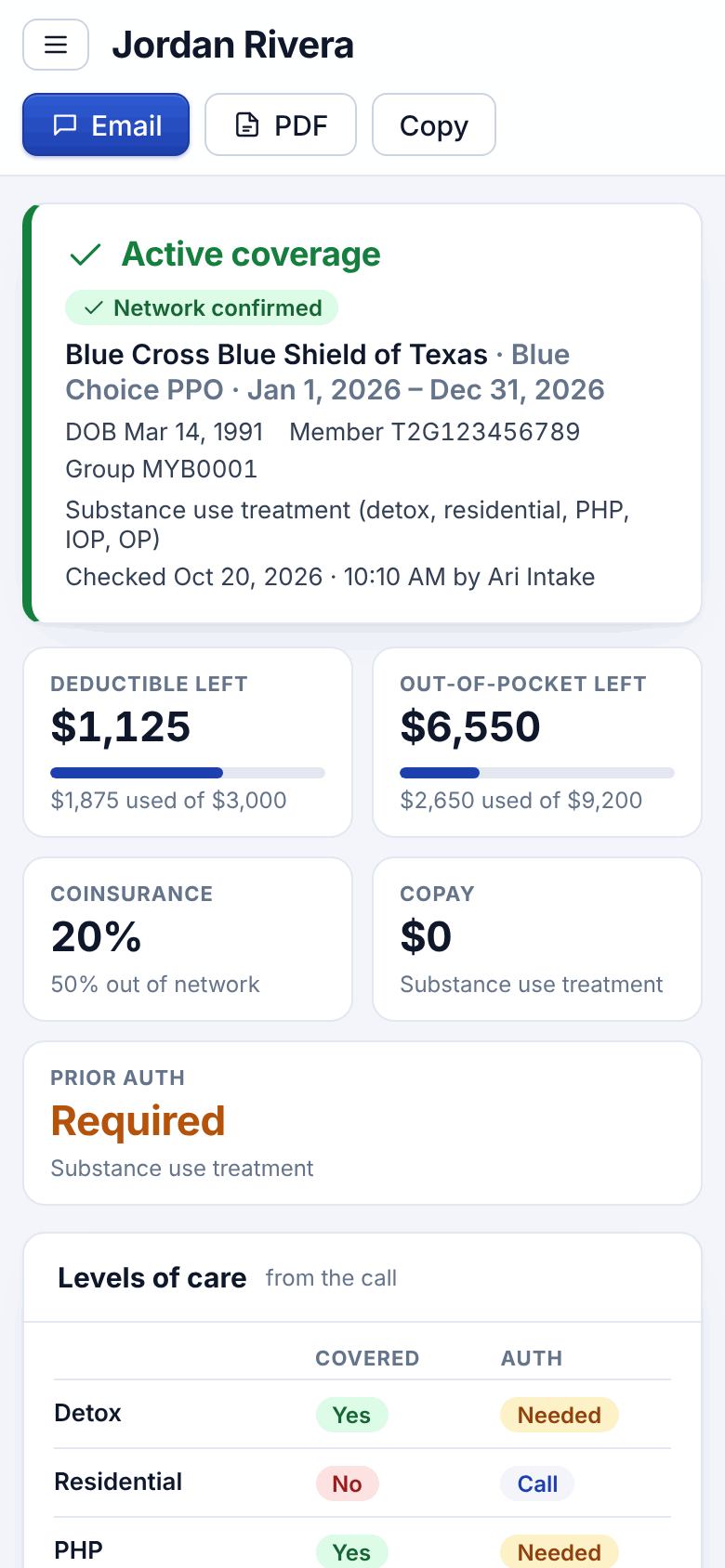
A check on a phone, with a made-up member and demo insurance.
Questions
What is the service type code for substance abuse in a 270/271?
AI (substance abuse). Some payers answer under AJ (alcoholism) or AK (drug addiction) instead, and some only under MH (mental health). For facility levels of care, CI is substance abuse facility inpatient (residential and detox) and CJ is substance abuse facility outpatient (IOP and OP).
What is the service type code for mental health?
MH. If a payer sends nothing for MH, try A4 (psychiatric) or A8 (psychiatric, outpatient). BB is partial hospitalization, and CG and CH are mental health facility inpatient and outpatient.
What does time qualifier 29 mean in a 271?
Remaining: the amount left to meet. A deductible with time qualifier 23 (calendar year) is the yearly total; the same deductible with 29 is what's left. The amount met is the total minus the remaining.
What does EB01 code U mean?
"Contact following entity for eligibility or benefit information": another company manages that benefit. The 2120 loop under it names the company and usually gives a phone number. For behavioral health, that's often a carve-out such as Optum, Carelon or Magellan.
Why does the 271 say nothing about IOP or PHP days?
Most payers don't send level-of-care limits or review schedules electronically. Ask for CI, BB and CJ, and expect to call for the rest.
Does "active coverage" mean the plan will pay?
No. It means the person had coverage for that service type on the date you asked. Payment still depends on the plan's terms, medical necessity, network status and authorization.
Skip the decoding
Quick VOB turns the 271 into the answer a family understands, in about a minute from a card photo. $99 a month for the whole team, checks billed by the question (usually about $1 a check). See it on a made-up member in the Quick VOB tour.
Sources
- 45 CFR §162.1202, Standards for eligibility for a health plan. ecfr.gov
- X12, External Code Lists (Service Type Codes). x12.org
- X12, Request for Interpretation 1821: EB*R vs EB*U vs EB*W; RFI 1275: 271 response when the source system is down. x12.org · x12.org
- Optum developer documentation, "Allowed Time Qualifier Reference" (EB06 values). developer.optum.com
- CMS, HETS 270/271 5010 format and element changes (AAA codes; matching rules). cms.gov
- U.S. Department of Labor, FAQs about Affordable Care Act Implementation (Part XXVII), May 2015 (self-only out-of-pocket limit applies to each person). dol.gov
- CMS, "The Mental Health Parity and Addiction Equity Act (MHPAEA)." cms.gov
This guide is general information, not legal or billing advice. Payers implement the 271 differently; confirm with each payer's companion guide and the current X12 implementation guide.
Read benefits, not code.
Snap the card and see what the client will pay, in about a minute. Free for 30 days.
Get early access