A free guide from Quick VOB
Insurance verification for detox and residential treatment
Detox and residential VOBs fail in different ways than outpatient ones: the wrong benefit, a missed notice window on a Saturday, three days approved when you planned for thirty. Here's what to check, what to ask, which codes and payer rules apply, and a timeline for the after-hours admission.
Updated October 24, 2026. Written by the admissions, UR and billing team of a licensed Texas IOP/PHP program.
The short answer: verify four things before a detox or residential admission. 1. The right benefit: residential and non-hospital detox usually fall under the plan's substance use facility inpatient benefit (service type CI), while detox in a hospital is usually the hospital's medical benefit. 2. The authorization rule: most plans require precertification before admission or notice within a short window after it; get the exact window and the after-hours number. 3. How days are approved: expect a few days at a time and frequent concurrent reviews. 4. The payer type: Medicare's coverage pages list hospital inpatient care, PHP and IOP but no non-hospital residential benefit; Texas Medicaid covers residential withdrawal management and treatment; TRICARE requires preauthorization for residential substance use care.
1. Which benefit pays for which level
| Level | Usually billed as | Ask the 271 for | Watch for |
|---|---|---|---|
| Hospital inpatient withdrawal management | The hospital's inpatient claim | The plan's general and hospital benefits (30, and the plan's inpatient lines) | It may be a medical benefit, reviewed by the medical plan, even when behavioral health is carved out. |
| Residential or non-hospital inpatient detox | A facility per diem | AI (substance abuse) and CI (substance abuse facility, inpatient) | Detox and residential share the CI benefit, so the 271 can't tell them apart. The call can. |
| Residential treatment | A facility per diem, sometimes with room and board separate | AI and CI | Day limits (an EB01 = F line), and whether the plan covers residential at all for this member. |
| Ambulatory withdrawal management | Outpatient services | AI and CJ (substance abuse facility, outpatient) | Medication and lab coverage, which may sit under the medical or pharmacy benefit. |
Ask for one service type per question and expect many payers to answer only their general benefit for CI. Our guide to reading a 271 lists every behavioral health service type code and what a silent answer means.
2. ASAM levels: the fourth edition's changes
Most plans decide residential and withdrawal-management requests against the ASAM Criteria or their own criteria built on it. The fourth edition (ASAM) no longer treats withdrawal management as a separate track:
- Level 3.5, clinically managed high-intensity residential, now includes what was Level 3.2-WM (clinically managed residential withdrawal management).
- Level 3.7, medically managed residential, now includes what was 3.7-WM.
- Level 4, medically managed intensive inpatient, includes inpatient withdrawal management and is the hospital level.
- Withdrawal management can be provided at other levels too, including the outpatient ones.
Some payer forms still use the third edition's names. When you call, say the level both ways ("ASAM 3.7, medically managed residential, which used to be 3.7-WM for the withdrawal piece") and write down which criteria the plan uses.
3. Precertification and notice windows
For detox and residential, the authorization rule matters more than the coinsurance. Plans set one of three rules, and the same plan can use different rules for detox and for residential:
| Rule | What it means at 9 PM on a Friday | What to write down |
|---|---|---|
| Precertification before admission | You need an approval before the person is admitted, so you need the plan's after-hours or urgent review line. | The after-hours number, the reference number, and the reviewer's name. |
| Admit, then notify within a window | You can admit, but must notify within the plan's window (for example, 24 hours or the next business day). | The exact window, how to notify (phone, fax, portal), and the time you did it. |
| No authorization required | Rare for these levels. Confirm it on the phone, not from a blank field on the 271. | The rep's name and the reference number for "no auth required." |
How long the plan has to decide depends on who regulates the plan. Texas HMO deadlines, the 24-hour rule for concurrent review during an inpatient stay, and the CMS deadlines for Medicare Advantage and Medicaid plans are in the prior authorization guide, along with what the reviewer will ask on each ASAM dimension.
4. What to ask, beyond the usual VOB
Run the standard questions from the VOB call script, then add these for detox and residential:
- Is withdrawal management at our facility a behavioral health benefit or a medical benefit, and who reviews it?
- Is residential substance use treatment covered for this member, in network and out of network?
- Precertification before admission, or notice after? How many hours, and what's the after-hours number?
- How many days are approved at first, and when is the first concurrent review?
- Is there a yearly day limit for residential or detox? How many days are used?
- Does the per diem include room and board, or is room and board billed separately or excluded?
- Which codes and claim form do you expect (revenue codes on a UB-04, or HCPCS per diem codes)?
- Does the plan require the facility to hold a particular license or accreditation for residential care?
- Are lab tests, drug screens and medications billed under this benefit or separately?
- Which criteria do you use for medical necessity: ASAM, or the plan's own?
Every answer has a box on the printable VOB form, in the Detox and Residential rows.
5. Medicare, Medicaid, TRICARE and out-of-state plans
| Payer | Detox and residential | Source |
|---|---|---|
| Original Medicare | Medicare's coverage pages list inpatient care in a general or psychiatric hospital, partial hospitalization, and (since 2024) intensive outpatient services. They don't list a residential treatment benefit at a non-hospital facility. The 2026 Part A inpatient deductible is $1,736 per benefit period. | Medicare.gov; CMS |
| Medicare Advantage | Each plan sets its own network, authorization rules and any extra benefits. Ask the plan directly about residential care. | The plan's evidence of coverage |
| Texas Medicaid | Covered residential substance use services include residential withdrawal management and residential treatment. The member's managed care plan runs the authorization; Superior HealthPlan, for example, requires prior authorization for withdrawal management and treatment services. | 1 TAC §354.1311; Superior HealthPlan |
| TRICARE | Covers residential substance use treatment, including withdrawal management, at authorized facilities. Preadmission and continued-stay authorization are required before nonemergency inpatient and residential substance use care is cost-shared. Check with the beneficiary's regional contractor. | TRICARE |
| Out-of-state Blue Cross plans | The member ID's three-character prefix routes the check to the member's home plan. The home plan's benefits and authorization rules apply, and behavioral health may be carved out. | See carve-outs |
6. Codes the plan will expect
Ask each plan which codes it wants, and check its billing manual; plans differ, and Texas Medicaid plans publish their own code lists. These are the common ones:
| Code | What it is | Where it goes |
|---|---|---|
| Revenue code 1002 | Behavioral health accommodations: residential treatment, chemical dependency | UB-04 (institutional claim) |
| H0010 / H0011 | Alcohol and/or drug services: sub-acute / acute detoxification, residential addiction program inpatient | HCPCS, per day |
| H0018 / H0019 | Behavioral health short-term / long-term residential (non-hospital), without room and board, per diem | HCPCS, per day; room and board, if covered, is separate |
| Place of service 55 | Residential substance abuse treatment facility | Professional claims (57 is the non-residential substance abuse treatment facility) |
Place-of-service codes come from CMS's code set. Revenue and HCPCS code use varies by payer; the plan's manual or contract wins.
7. The Friday-night admission, step by step
| When | Do |
|---|---|
| The first call | Get photos of both sides of the card and the patient's date of birth, and the subscriber's if the patient is a dependent. For a 42 CFR Part 2 program, get signed consent before you contact the payer. |
| Within minutes | Run the electronic check for AI and CI. Note the deductible and out-of-pocket left, any day limit, and any carve-out or "contact following entity" line; if there is one, check with that company too. |
| Before admission | Call the precert or after-hours line from the card. Learn the rule (precert, or notice within a window), and get a reference number either way. Tell the family what they'll owe, using the deductible and out-of-pocket scripts. |
| At admission | Record the admit time. If the plan wants notice, set an alarm for the window. |
| Within the window | Notify or request authorization with the clinical information ready: withdrawal risk, vitals and scale scores, medical and psychiatric conditions, the ASAM ratings. |
| The next business day | Re-check eligibility, confirm the authorization number and the days approved, and put the last approved day and the first concurrent review on the calendar with an owner. |
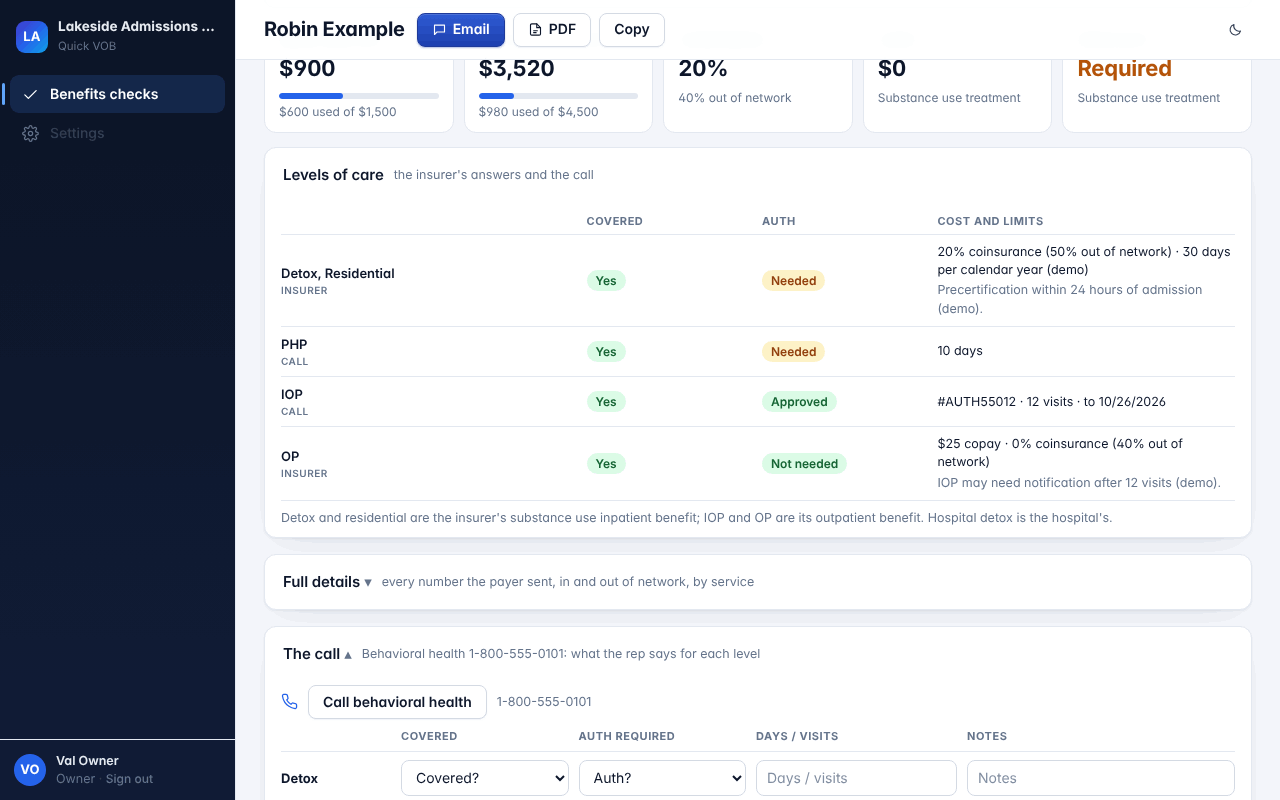
Quick VOB's levels of care for a made-up member: detox and residential answered together from the insurer's inpatient facility benefit, the other levels from the call.
8. Plan the step-down on day one
A residential stay that ends without a plan for what comes next is a readmission risk and a hard concurrent review. Verify the next level (PHP or IOP) during the first week: each level is its own benefit and usually its own authorization, and the outpatient program may be in network when the residential program isn't. Reviewers ask for the discharge plan at every concurrent review; the prior authorization guide lists what they look for.
Quick VOB asks the payer about detox and residential with one question (they share the CI benefit), PHP with another and IOP and OP with a third, then logs what the rep said for each level and tracks every authorization by its last day. Programs that also run PHP and IOP can keep the authorizations, attendance and continued-stay reviews on the chart with Cima EHR for IOP and PHP.
Opening or adding a residential or detox level in Texas? Those services need a chemical dependency treatment facility license from Texas HHSC (Health and Safety Code ch. 464), and payers ask for it when they credential the facility. Cima Consulting's guide to starting a program in Texas covers the license.
Questions
Does insurance cover detox?
Commercial plans commonly cover medically necessary withdrawal management, and Texas Medicaid and TRICARE cover it too, usually with precertification or notice. Hospital detox is often a medical benefit; detox at a residential facility is usually the substance use inpatient facility benefit. Verify which, and the authorization rule, before admission.
Does insurance cover residential rehab?
Many plans do, subject to medical necessity, network status and authorization, often in short blocks of days with concurrent reviews. Original Medicare's coverage pages don't list a non-hospital residential benefit, so ask a Medicare Advantage plan directly.
How many days of residential treatment will insurance pay for?
There's no standard number. Plans approve a few days at a time and extend based on concurrent reviews; some plans also have a yearly day limit. Ask how many days come first, when the first review is, and whether a limit applies.
Is detox billed to the medical plan or the behavioral health plan?
It depends on the plan and the setting. Hospital detox is commonly a medical benefit; detox in a residential facility is commonly behavioral health, and may be managed by a carve-out. Ask on the call and note who reviews it.
What if a client arrives on a weekend and the plan requires precertification?
Call the plan's after-hours or urgent review line on the card before admitting. If the plan allows notice after admission instead, write down the window and notify within it. Either way, record the time, the person you spoke to and the reference number.
Do we need a new authorization when a client steps down to PHP or IOP?
Usually yes. Each level is a separate benefit with its own authorization. Verify the next level early in the stay.
Verify the inpatient benefit in about a minute
Quick VOB asks for detox and residential, PHP, and IOP and OP separately, keeps what the rep said, and tracks every authorization to its last day. $99 a month for the whole team, checks usually about $1. Common questions are in the Quick VOB FAQ.
Sources
- American Society of Addiction Medicine, The ASAM Criteria, 4th edition. asam.org
- Medicare.gov, "Mental health & substance use disorder services"; CMS, "2026 Medicare Parts A & B Premiums and Deductibles." medicare.gov · cms.gov
- 1 Texas Administrative Code §354.1311 (residential substance use disorder treatment services). regulations.justia.com
- Superior HealthPlan, "Behavioral Health Providers: Service and Claim Billing Guidelines for Withdrawal Management and Treatment Services." superiorhealthplan.com
- TRICARE, "Residential Substance Use Disorder Treatment." tricare.mil
- CMS, Place of Service Code Set. cms.gov
- Texas Health and Safety Code chapter 464, Facilities Treating Persons with a Chemical Dependency. statutes.capitol.texas.gov
This guide is general information, not legal, clinical or billing advice. Payer rules differ by plan and change; confirm with each plan, its medical policies, its billing manual and your contracts.
Admit with the authorization rule in hand.
Benefits for every level of care, the call, and the authorization tracked to its last day. Free for 30 days.
Get early access