A free guide from Quick VOB
Prior authorization for SUD and mental health levels of care
What triggers a prior authorization, what the reviewer will ask at the first review and every review after, how long the plan has to answer, and what to do when the answer is no. Written for admissions, UR and billing staff at detox, residential, PHP, IOP and outpatient programs.
Updated October 24, 2026. Written by an IOP/PHP program's admissions, UR and billing team.
1. The words: prior auth, precert, concurrent review
Plans use different names for the same few steps. Learn the plan's words, then ask the same questions every time.
| Term | What it means for you |
|---|---|
| Prior authorization, preauthorization, precertification | The plan approves a level of care before you deliver it, or within a set time after admission. Without it, the claim is usually denied even when the care was right. |
| Notification | Some plans only want to be told about an admission within a set time, with no approval step. Missing the deadline can still cost you the claim. |
| Concurrent review, continued-stay review | While the client is in care, the plan reviews progress and decides whether to approve more days or visits. |
| Retrospective review | A review after care is delivered. Don't count on it when an authorization was required and nobody asked for one. |
| Utilization review agent | Whoever does the review: the plan itself, or a separate company it hired. For behavioral health that is often a carve-out such as Optum, Carelon or Magellan. |
2. What triggers a prior authorization
The level of care is the main trigger. The pattern below is common, but it is not a rule. Every plan sets its own list, so ask for each level you might use.
| Level of care | Prior authorization | Ask about |
|---|---|---|
| Inpatient detox (withdrawal management) | Commonly required; some plans want notice soon after admission | The notice deadline, and whether detox is a medical or a behavioral health benefit |
| Residential | Commonly required before admission | Whether residential is covered at all, and the days approved per review |
| PHP | Commonly required | Days approved at first, and the date of the first concurrent review |
| IOP | Often required | Visits or days approved, and whether notice is enough |
| Outpatient (OP) | Less often; some plans after a set number of visits | Visit limits, and when an authorization starts to be needed |
Other events that usually need a new authorization or a new review:
- A step down or step up. PHP to IOP, or IOP to outpatient, is a new level of care with its own approval.
- A new plan year or a new plan. An authorization rarely carries over when the coverage changes.
- Out-of-network care, or a single-case agreement.
- The last approved day. Care past it needs a continued-stay review before it, not after.
An electronic benefits check (the 271) sometimes says "prior authorization required" for a service type, but payers rarely send it for each level of care. Treat "not indicated" as "ask," not as "no." Our VOB checklist lists what to ask the rep.
3. The first review: what to have ready
A reviewer decides whether this person needs this level of care now. Have the answers in front of you before you call or submit the form. Most plans want:
- The diagnosis, with the ICD-10 code, and the substance or substances, how much, how often, and the last use.
- Withdrawal risk: past withdrawal, seizures or DTs, and any withdrawal scale you used.
- Medical and psychiatric conditions, current medications, and any risk to self or others.
- Treatment history: earlier admissions, what level, and how it went. "Outpatient was tried and failed" needs dates and specifics.
- The recovery environment: housing, people who use around them, work, legal pressures, supports.
- The plan: the level of care, the schedule (hours and days a week), the goals, the expected length of stay, and the discharge plan.
- A rating on each ASAM dimension (below), with a sentence on why.
Before you hang up or submit, write down the reviewer's name, the authorization number, the level, the days or visits approved, the first and last day, and the date of the next review.
4. The six ASAM dimensions
Many plans review substance use care against the ASAM Criteria, published by the American Society of Addiction Medicine. Payer review forms ask for a risk rating and a short description for each dimension, at the first review and at every concurrent review. The fourth edition names them:
- Intoxication, withdrawal and addiction medications
- Biomedical conditions
- Psychiatric and cognitive conditions
- Substance use-related risks
- Recovery environment interactions
- Person-centered considerations
Some payer forms still use the third edition's names, such as "readiness to change" and "relapse, continued use or continued problem potential." Use the form's words, and make sure every rating has a reason a stranger can check in the chart.
5. Continued-stay reviews
A concurrent review asks a different question: why does this person still need this level, and what would let them step down? Reviewers look for change. A note copied forward from last week reads as no progress, or as no need.
- Progress on each treatment plan goal, in measurable terms, since the last review.
- Updated ratings on each ASAM dimension, with what changed.
- Attendance: hours and days attended against the schedule.
- Drug screens, cravings, use or lapses, and how the plan changed in response.
- What still needs this level, and the step-down criteria and date you're working toward.
- The discharge plan: the next level of care, the provider, and the appointment.
Some plans set a documentation bar for the level itself. One payer's PHP policy, for example, asks for a documented daily clinical assessment and weekly substance use and medication evaluations for continued stay. Read the medical policy for each plan you bill often.
Write the review before the last approved day. Late work gets a dated late-entry note, never a backdated one.
6. How long the plan has to answer
Deadlines depend on who regulates the plan. A few that apply to many Texas programs:
| Plan type | Deadline | Source |
|---|---|---|
| Medicare Advantage, Medicaid and CHIP (fee-for-service and managed care) | 72 hours for an expedited (urgent) request; 7 calendar days for a standard request, starting mainly in 2026. A denial must give a specific reason. | CMS Interoperability and Prior Authorization final rule (CMS-0057-F) [1] |
| Texas HMO (state-regulated) | A preauthorization decision by the third calendar day after the request is received. | Texas Insurance Code §843.348(d) [2] |
| Texas HMO or PPO, during an inpatient stay | Within 24 hours of the request for concurrent hospitalization care. | 28 TAC §19.1718 [3] |
| Self-funded employer plans | Not regulated by the Texas Department of Insurance; federal law (ERISA) and the plan's own documents apply. | Texas Department of Insurance [4] |
How to tell from the card: the Texas Department of Insurance says a card without "TDI" or "DOI" on it is from a self-funded plan, which TDI doesn't regulate [4]. Rules change and have exceptions; check the current text and the plan's own documents before you rely on a deadline.
Texas also has a "gold card" law: a state-regulated plan can't require preauthorization of a service from a provider whose requests for it it approved at least 90 percent of the time over the last six-month evaluation period [5]. It does not reach self-funded plans.
7. Denials and peer-to-peers
In Texas, before a utilization review agent issues an adverse determination that questions medical necessity, it must give the treating provider a chance to discuss the case, often called a peer-to-peer. The discussion must cover, at least, the clinical basis for the decision and what documentation could change the outcome [6]. Once the denial letter is out, usually only an appeal can change it.
Get ready for a peer-to-peer in ten minutes:
- One page: the diagnosis, the ASAM dimensions rated moderate or higher and why, safety risks, and what happened at lower levels of care.
- The plan's own criteria. Ask the reviewer which criteria they used, and answer them point by point.
- A clinician who knows the client on the call, with the chart open.
- A fallback. If the plan won't approve this level, ask what it will approve, for how long, and when to send more.
If the denial stands, the notice must state the principal reasons and the clinical basis [7]. Appeal in writing, attach the missing documentation, ask for an expedited appeal when the client is in care, and keep every reference number. If the plan's rep told you on the VOB call that no authorization was needed, that call's date, rep name and reference number are your best evidence.
8. Never lose an authorization
Most lost authorizations aren't denials. Nobody owned the last day. Whatever tool you use, keep one list of open authorizations sorted by last day, with an owner and a reminder far enough ahead to write and send the continued-stay review. We use 5 days.
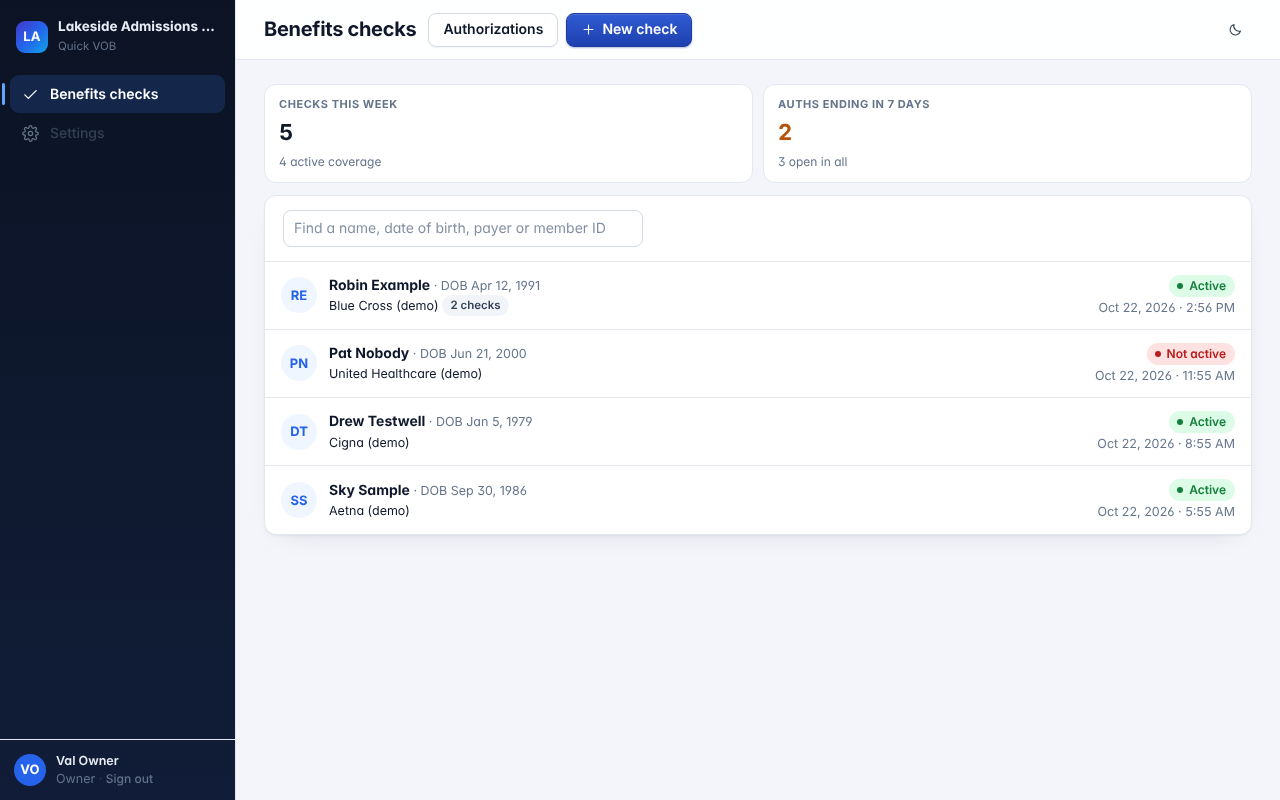
Quick VOB's checks list, with made-up people: authorizations ending in the next 7 days are counted at the top.
In Quick VOB, after the payer approves care, you add the authorization to the check: the level of care, the auth number, the first and last day, and what was approved (for example "12 visits"). Then:
- Authorizations lists every open one by its last day.
- The owner and the billers get an email 5 days before the last day, with only the client's initials and the VOB number in it.
- Extended sets a new last day, and a new reminder, in two taps.
- The authorization is on the VOB PDF and in Copy for my EHR, so it lands in your chart too.
Quick VOB tracks authorizations; it doesn't write your continued-stay reviews. If you want the reviews prompted and drafted from the chart, that's part of Cima EHR for IOP and PHP programs.
Verify benefits and track every authorization
Snap the card, see the benefits in about a minute, log the call by level of care, and get an email 5 days before each authorization ends. $99 a month for the whole team.
More from Quick VOB: the VOB checklist · behavioral health carve-outs · VOB software vs outsourcing · Quick VOB questions · Quick VOB home
Sources
- Centers for Medicare & Medicaid Services, "CMS Finalizes Rule to Expand Access to Health Information and Improve the Prior Authorization Process," January 17, 2024 (qualified health plans on the federal exchanges are excluded from the decision deadlines). cms.gov
- Texas Insurance Code §843.348, Preauthorization of health care services. texas.public.law
- 28 Texas Administrative Code §19.1718, Preauthorization for health maintenance organizations and preferred provider benefit plans. regulations.justia.com
- Texas Department of Insurance, "Fully insured vs. self-insured" and "Getting help with a health plan that TDI doesn't regulate." tdi.texas.gov · tdi.texas.gov
- Texas Insurance Code §§4201.651–4201.659, Exemptions from preauthorization requirements. texas.public.law
- Texas Insurance Code §4201.206, Opportunity to discuss treatment before adverse determination; Texas Department of Insurance Bulletin B-0008-19 (citing 28 TAC §19.1710). tdi.texas.gov
- Texas Insurance Code §4201.303, Adverse determination: contents of notice. codes.findlaw.com
- American Society of Addiction Medicine, The ASAM Criteria, 4th edition. asam.org
- Payer review forms that ask for each ASAM dimension: Amerigroup Georgia behavioral health concurrent review form; Wellpoint Iowa concurrent review form (inpatient, residential, PHP, IOP). PHP continued-stay documentation: Univera Healthcare, "Partial Hospitalization for Substance Use Disorders." amerigroup.com · wellpoint.com · univerahealthcare.com
This guide is general information, not legal, clinical or billing advice. Payer rules differ by plan and change; confirm with each plan, its medical policies and your contracts.