A free form from Quick VOB
VOB form template: a printable insurance verification form for treatment admissions
One page for every benefits check: the card, the eligibility response, what the rep said for detox, residential, PHP, IOP and outpatient, the authorization, and what you told the family. Fill it in on screen or print it blank.
Updated October 24, 2026. Written by the admissions and billing team of a licensed Texas IOP/PHP program.
The short answer: a verification of benefits (VOB) form records, in one place, whether a person's insurance is active, what they still owe toward the deductible and out-of-pocket maximum, whether each level of care is covered and needs prior authorization, who the payer's rep was and the call reference number, and the authorization once it's approved. The form below has those eight parts in the order the work happens. Nothing you type on this page is saved or sent anywhere; it stays in this browser tab until you print it or close it.
How to use the form
- Start a form the moment the caller gives you insurance. Ask for photos of the front and back of the card before anything else. Most failed checks start with a mistyped member ID or a missing prefix.
- Fill parts 1 to 4 from the card and the electronic eligibility check (the X12 270/271 transaction your clearinghouse or the payer's portal runs). Our guide to reading an eligibility response explains every number you'll copy.
- Call the behavioral health number for parts 5 and 6. Payers rarely send level-of-care answers electronically. Use the VOB call script so every rep gets the same questions.
- Run the check again the day before admission. Coverage verified on a Friday can end on the first of the month.
- Fill part 7 when the payer approves care, and put the last authorized day on a calendar with a reminder 5 days ahead, in time for the continued-stay review.
- Fill part 8 after you talk money with the family, then have billing review and sign. The deductible vs out-of-pocket guide has the words to use.
1. The check
2. The person
3. The card
4. Eligibility (from the 271 or the portal)
Write the total and what's left. Met = total minus left.
| Accumulator | In-network total | In-network left | Out-of-network total | Out-of-network left |
|---|---|---|---|---|
| Deductible, individual | ||||
| Deductible, family | ||||
| Out-of-pocket max, individual | ||||
| Out-of-pocket max, family |
5. Levels of care (from the call)
| Level | Covered? Y/N | Auth? Y/N | Who reviews; phone, fax or portal | Days or visits at first | Cost share | Limits, codes, notes |
|---|---|---|---|---|---|---|
| Detox | ||||||
| Residential | ||||||
| PHP | ||||||
| IOP | ||||||
| OP |
6. The call
7. Authorization
8. What the family was told
Benefits are what the payer said at the time of the check and the call. They are not a guarantee of payment; coverage is subject to the plan's terms, medical necessity and authorization.
Field by field: what goes wrong
| Part | Get this right | Why it matters |
|---|---|---|
| 1. The check | The date and the time, and who ran it. | A benefits answer is true at the moment it was given. If a claim is denied later, the time and the person are part of your evidence. |
| 2. The person | The patient's name and date of birth exactly as the plan has them; the subscriber's name and date of birth when the patient is a dependent. | Checking the dependent as the subscriber (or the other way around) is the most common reason a payer answers "not found." For a program covered by 42 CFR Part 2, a person who has applied for substance use treatment is already a "patient," so get the signed consent before you call the payer. |
| 3. The card | The member ID with its letter prefix, the group number, and every phone number on the back. Note whether "TDI" or "DOI" is printed on the card. | A separate behavioral health number usually means a carve-out. The Texas Department of Insurance says a card without TDI or DOI is usually from a self-funded plan, which follows federal rules instead of Texas insurance law. |
| 4. Eligibility | Total and amount left for each accumulator, in and out of network, individual and family; and whether the plan resets on January 1 or on its own plan year. | Payers send totals and remaining amounts as separate lines. Copying the total into "left" overstates what the family owes. The deductible and out-of-pocket numbers are what part 8 is built from. |
| 5. Levels of care | One row per level you might use, filled from the call. | Detox and residential usually sit under the plan's inpatient facility benefit, IOP and OP under its outpatient facility benefit, and PHP on its own. "Covered" for one level says nothing about another. See VOBs for detox and residential. |
| 6. The call | The rep's name, the reference number, and the time, read back to the rep before you hang up. | If the plan denies care the rep said needed no authorization, the reference number is how you appeal. |
| 7. Authorization | The auth number, the level, the first and last day, what was approved, and one named owner. | Most lost authorizations aren't denials; nobody owned the last day. The prior authorization guide covers what reviewers ask. |
| 8. The family | The deductible left, the coinsurance, and the out-of-pocket left, in network, and who you told. | An out-of-network program is a different conversation with different numbers; see out-of-network benefits for addiction treatment. |
A filled-in example
Here is one check, for a made-up member and demo insurance, the way a completed form reads. The numbers match the Quick VOB PDF below.
| Field | What was written |
|---|---|
| Card | Blue Cross (demo) PPO · member XDM555123 · group G100 · subscriber is the patient · no TDI on the card, so ask whether the plan is self-funded |
| Eligibility | Active 01/01/2026 to 12/31/2026 (calendar year) |
| Deductible | In network: $1,500 individual, $900 left; $3,000 family, $2,100 left. Out of network: $3,000 individual, all of it left |
| Out-of-pocket max | In network: $4,500 individual, $3,520 left; $9,000 family, $7,800 left |
| Cost share | 20% coinsurance in network after the deductible |
| Carve-out | Substance use treatment handled by Magellan (demo): checked and called them too |
| Levels | Detox and residential: covered, auth needed, precert within 24 hours of admission, 30 days a calendar year. PHP: covered, auth needed, 10 days at first. IOP: covered, auth needed. OP: covered, $25 copay, no auth |
| Call | 800-555-0101 · rep Kim (demo) · ref REF-20261022-01 · 10/22/2026 7:57 PM · read back: yes |
| Authorization | IOP · #AUTH55012 · 12 visits · last day on the calendar with a reminder 5 days before |
| Family told | "Your share starts with the $900 left on your deductible, then 20% of the plan's rate, and the most you can pay this year for in-network care is $3,520." |
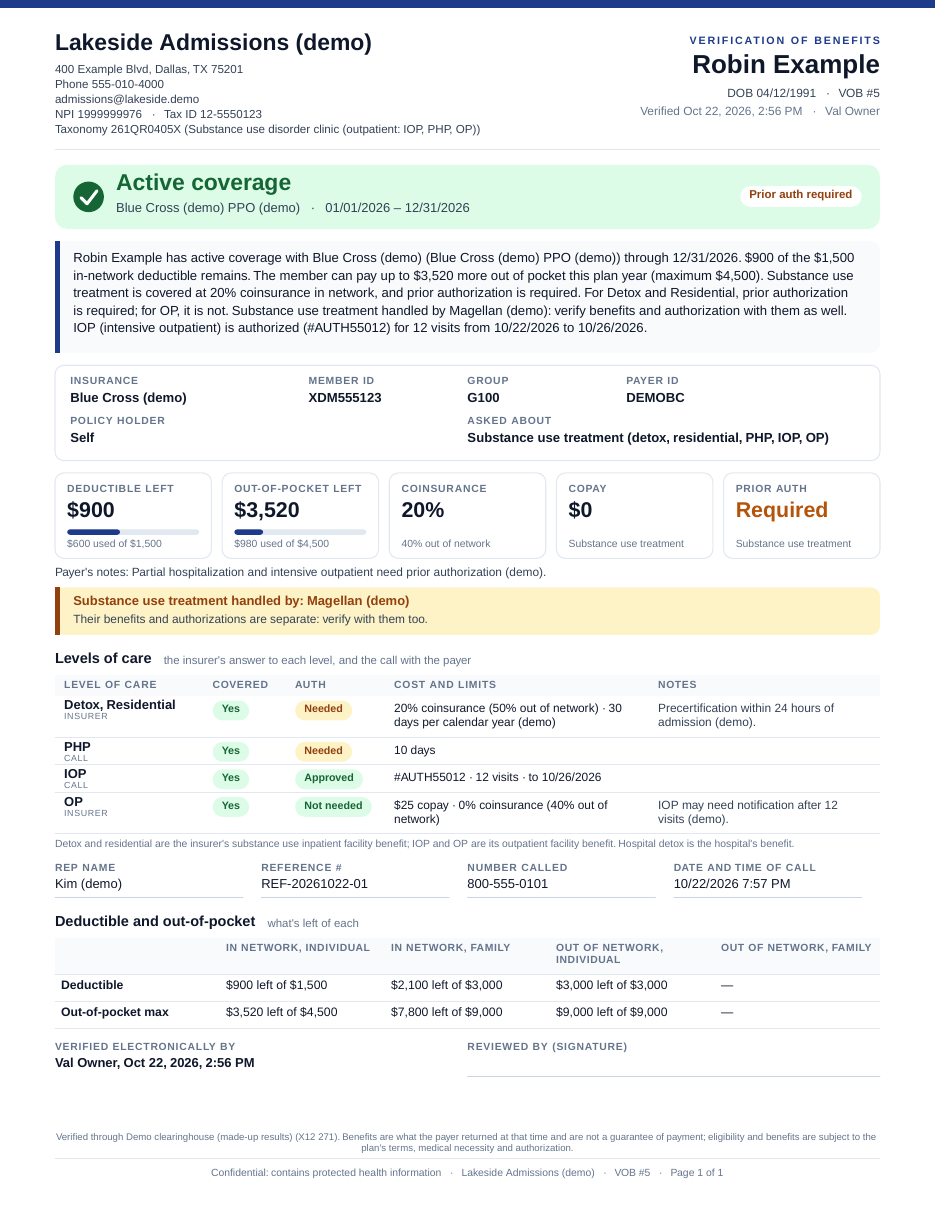
The same check as a Quick VOB PDF, with a made-up member and demo insurance: every part of the form, filled from a card photo and the payer's answer.
What to keep in the chart
- One form per check, including the re-check before admission and each new check after a step-down, a new plan year or new insurance.
- The card photos, front and back.
- Billing's signature on part 8, so the business office knows what the family was told before the first statement goes out.
- The authorization and each extension, with the reviewer's name. Surveyors and payer auditors look for a VOB and the auth trail when they pull a chart; Comply's chart audit checklist shows how they read one.
Paper works for a handful of admissions a week. Past that, the form gets filled from memory at 9 PM and the authorization dates end up on a sticky note. Quick VOB fills parts 1 to 4 from a card photo and the payer's answer in about a minute, keeps the call by level of care, and emails the owner and billers 5 days before each authorization ends. If you'd rather keep the authorizations on the chart with the continued-stay reviews, that is part of Cima EHR for IOP and PHP programs.
Questions
What is a VOB form?
A VOB (verification of benefits) form is the admissions team's record of a person's insurance benefits before treatment: whether coverage is active, the deductible and out-of-pocket maximum with what's left, coinsurance and copays, network status, whether each level of care is covered and needs prior authorization, and the rep's name and call reference number.
What should a VOB form include for a treatment program?
At least: the card details including the member ID prefix and every phone number; active dates; deductible and out-of-pocket, in and out of network, individual and family, total and left; coinsurance and copays; any carve-out; each level of care (detox, residential, PHP, IOP, OP) with coverage, prior authorization, who reviews and how many days or visits come first; the rep, reference number and time; and the authorization once approved. The VOB checklist explains each item.
Is a completed VOB a guarantee that the plan will pay?
No. A VOB is what the payer said at that moment. Payment still depends on the plan's terms, medical necessity and authorization. That's why the form keeps the time, the rep's name and the reference number.
Do we need a new VOB when a client steps down from PHP to IOP?
Usually a new authorization at least, because the new level is a different benefit. Run a fresh check too when the plan year turns over or the client's insurance changes.
Is it safe to type a patient's details into this page?
The page doesn't save or send what you type, and it asks the browser not to remember the fields. A printed or saved copy is protected health information, so file it in the chart, not in a shared folder or an email.
Can I edit this form for my program?
Yes. Print it, or copy the parts into your EHR's VOB template. Keep the order (card, eligibility, levels, call, authorization, family): it follows the work.
Let Quick VOB fill the form
Snap the card, see the benefits in about a minute, log the call by level of care, and get a reminder before each authorization ends. $99 a month for the whole team, checks billed by the question (usually about $1 a check), $200 one-time setup. Questions first? Read the Quick VOB FAQ or take the tour.
Sources
- Electronic Code of Federal Regulations, 45 CFR §162.1202, Standards for eligibility for a health plan (the X12 270/271 transaction). ecfr.gov
- Electronic Code of Federal Regulations, 42 CFR Part 2, Confidentiality of Substance Use Disorder Patient Records (§2.11, definition of "patient"). ecfr.gov
- Texas Department of Insurance, "Fully insured vs. self-insured." tdi.texas.gov
- HealthCare.gov glossary, "Out-of-pocket maximum/limit." healthcare.gov
- CMS, Uniform Glossary of Coverage and Medical Terms (allowed amount, coinsurance, deductible). cms.gov
This form is general information, not legal or billing advice. Payer rules differ by plan and change; confirm with each plan and your contracts.
Stop filling VOB forms by hand.
Card photo to benefits in about a minute, the call by level of care, and every authorization tracked. Free for 30 days.
Get early access